 ⤢ Click to enlarge GELATO
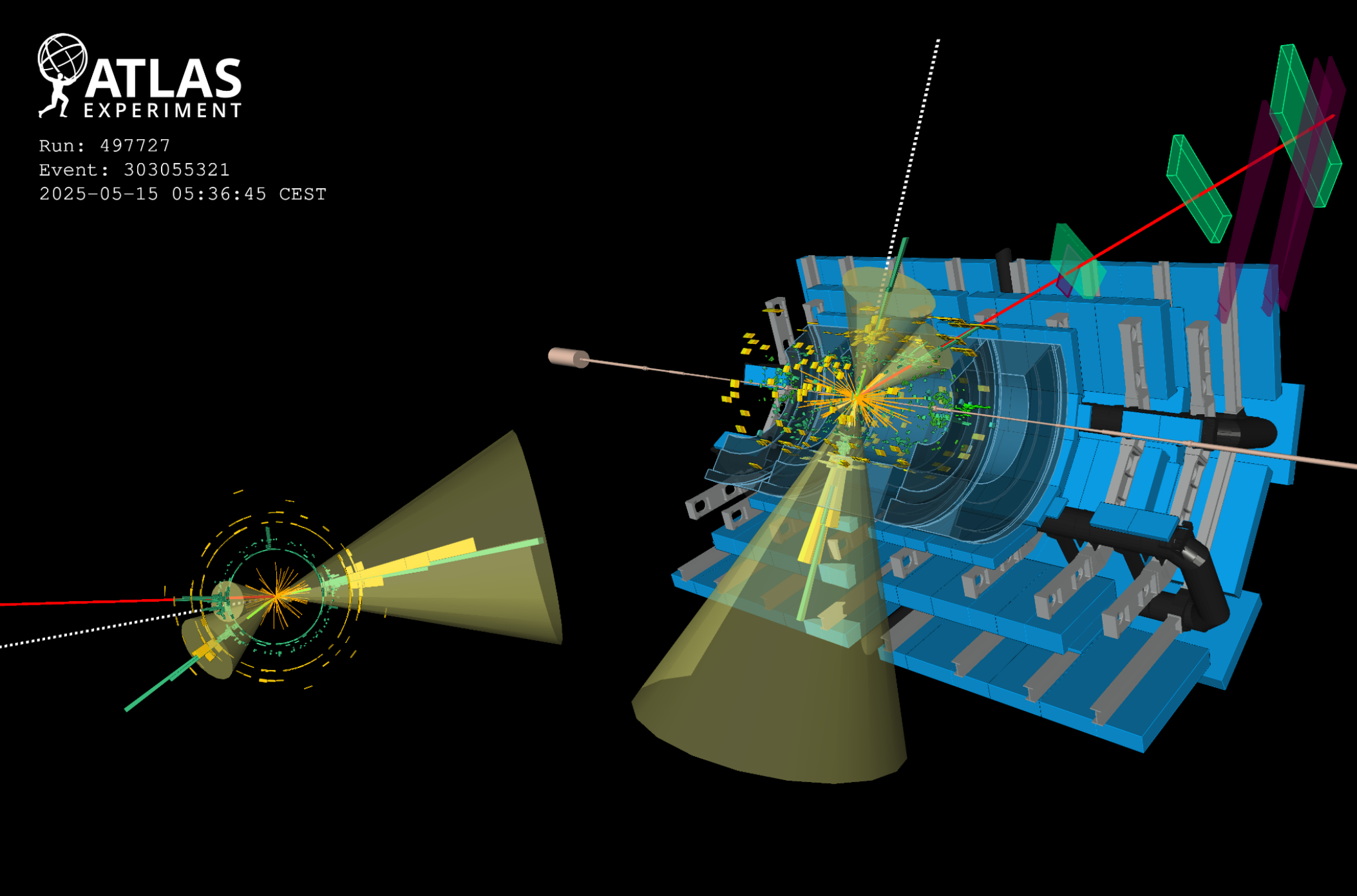
 A Generic Event-Level Anomaly detection Trigger for ATLAS: here is the event display of a GELATO L1-fired event with the highest GELATO HLT AD score during May 2025, at 13.6 TeV.
Physics Ph.D. candidate building interpretable, ultra-fast machine learning to spot new physics at the world's largest particle collider.
I'm a Ph.D. candidate in Physics at SLAC and Stanford, working on the ATLAS experiment at the LHC at CERN, advised by Dr. Julia Gonski and Dr. Dong Su. I'm also an affiliated trainee of the A3D3 Institute under the NSF HDR program.
At the LHC, particles collide 40 million times a second, generating up to one petabyte raw data per second — too fast and too large to store. I build machine learning models running directly on hardware at the edge, where decisions happen in tens of nanoseconds. I focus on interpretable anomaly detection, to find rare, anomalous events that could signal physics beyond the Standard Model.
⤢ Click to enlarge GELATO A Generic Event-Level Anomaly detection Trigger for ATLAS: here is the event display of a GELATO L1-fired event with the highest GELATO HLT AD score during May 2025, at 13.6 TeV.
A contrastive-learning framework that surfaces extremely rare decay anomalies — like long-lived particles — that standard algorithms miss.How it works →Read the paper (arXiv:2608.13652) →
ATLAS Collaboration author since March 2026.
Papers I am an author on with the ATLAS Collaboration.
Loading from InspireHEP…